
Europe’s Cassandra
The Camp of the Saints Fifty Years Later

In Homeric mythology, Cassandra of Troy is cursed with a terrible fate: to foresee the future, but never to be believed. She warned the people of her city not to accept the wooden horse from the Greeks, but they ignored her. Soon after, all that remained of Troy was smoldering ruins and the lamentations of widows.
In the waning decades of the last century, skeptics of mass immigration faced an eerily similar fate. British MP Enoch Powell, citing Virgil in his now-infamous 1968 speech on immigration, declared, “As I look ahead, I am filled with foreboding; like the Roman, I seem to see ‘the River Tiber foaming with much blood.’” For this warning, he was branded a racist, and immigration restriction was declared a forbidden topic in British politics.
Jean Raspail’s 1973 masterpiece The Camp of the Saints, however, stands apart from all other prophecies of doom in the modern age. Few works can compare to its incisive commentary, prescience, or in how thoroughly it has been ignored and suppressed in the Western world.
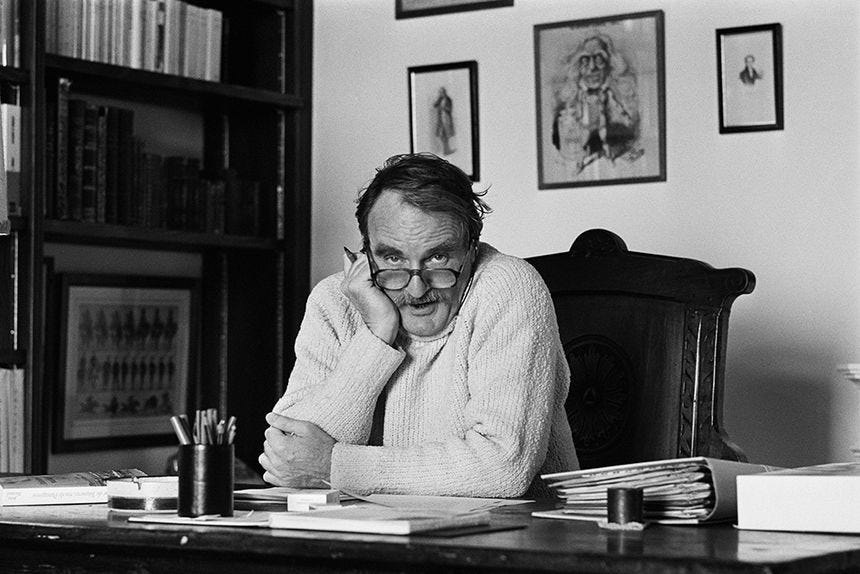
Unlike the Left’s favorite “banned books,” The Camp of the Saints has been nearly impossible to acquire, subject to censorship in France and entirely suppressed in the English language by major publishing houses. Thankfully, Vauban Books released the first new translation last month, at last making the book available to a whole new audience. The timing could not be more relevant.
Raspail saw clearly both the internal and external threats facing the West, which are now manifesting in ways few others could have expected fifty years ago. He wrote, in words that ring ever more valid today:
The world seems to be controlled, not by a single orchestra conductor, but by a new apocalyptic beast, a sort of anonymous, omnipresent monster who has vowed, first and foremost, to destroy the West… Perhaps it is of divine or, more likely, demoniacal origin? - Ch. XIV.
Though it is easy to mock those shifting blame for modernity onto literal demons, it is impossible to deny, when faced with the outpouring of violence and hate from the Left in the last few years, that malevolent forces are at work.
Yet The Camp of the Saints is not, first and foremost, a cautionary tale about mass migration. Rather, it is a scathing look into the soul of the West. Raspail explores, with clarity and lifelike imagery, the motives and ideology of Europe’s home-grown Leftists who seek the annihilation of their own civilization, the conservatives who dither and cower rather than oppose them, and the treason of the West’s own institutions, especially its greatest: Christianity.
Instead of a mere warning, Raspail offers a provocation: “If one wishes to understand Western opinion as regards the immigrant fleet or indeed anything else of a foreign nature, one essential fact must be borne in mind: to wit, that it did not give a damn about anything.” Understanding this apathy has ever-greater urgency today.
The Decolonization Paradigm and the Psychopath Left
The Camp of the Saints is filled with examples of European leftists aiding and abetting the enemies of the West, from atheist reporters to rogue bishops. These characters, no doubt, stand in for real figures, or at least real human types; Leftist intellectuals of Raspail’s own time, such as Jean-Paul Sartre, come to mind. Each has his own personality and motivations, yet they are all united by self-hatred, a shame at the West's success, and a desire for the cleansing fire of oblivion.
This leads Raspail’s leftists to champion any cause, as long as it opposes the West and its traditional values and way of life. The central figures of these causes thus became a sort of “anti-Joan of Arc,” contrasted to France’s patron saint and historical savior from foreign domination. This figure, according to Raspail,
became, in turn, the despised Arab worker; the pornographic publisher on trial; the exploited Negro builder; the censored director; the red Madonna of the favelas; the rioter roughed up by police; the murdered tough guy from the pub; the academic terrorist; the schoolgirl who had an abortion; the director of the cultural center, summarily fired; the hemphead prophet; the prosecutor of the people’s tribunal; the married priest; the sexually active fifteen year old; the incestuous writer; the pop guru; the pedophile professor; the guy who took a shit on the tomb of the Unknown Soldier; the hunger-striking neurotic deserter; the gangland leader of the projects; the homosexual medically exempt from the draft; the sadistic high school bully; the rapist driven to crime by pornography; the righteous hostage taker; the delinquent, victim of heredity or social pressure; the abortionist proclaiming human dignity; the back country Brazilian woman sold in the brothels of São Paulo; the Indian who contracts the tourist’s measles and dies; the murderer agitating for prison reform; the bishop publishing his Marxist pastorals; the car thief enamored of speed; the bank robber enamored of the images of luxury in advertising; the cherry-popper enamored of sexual liberation; the Bengali man dead of hunger …And so many others, all crusading heroes and sometimes well chosen indeed. Many of them were appealing, convincing. And why not? The unbridled heart is a great bazaar. - Ch. XVI
A quick glance at today’s left-wing media, whether in journalism, progressive nonprofit websites, or art-house films, would furnish examples of each of these archetypes being held up as heroes and martyrs: George Floyd, Kyle Rittenhouse’s attackers, and Assata Shakur come to mind in recent history.
Yet none of these figures are themselves the core of the Left; they are at best client demographics, foot soldiers, and poster children. The real Leftist, Raspail shows, is something far more sinister and despicable.
The book places the Leftist type on full display in its second chapter in the figure of a young radical who confronts an elderly professor. Raspail describes this character in terms reminiscent of today’s Antifa rioters, campus revolutionaries, the would-be assassin of Donald Trump, and the successful assassin of Charlie Kirk. He is one of “those parasitic marginals that Europe had secreted by their hundreds of thousands and who already formed, like a cancer, a sort of volunteer Third World within it.”
This creature cheers the coming of the migrant fleet and relishes the thought of the violence and destruction which will inevitably come in its wake. He declares with glee to the professor, “I think you’re perfect. That’s why I hate you. And it’s here, to your house, that I’ll bring the most wretched ones tomorrow… They’ll build a fire with your lovely oak door. They’ll shit all over your terrace and wipe their hands on the books in your library.”

These words perfectly embody Nietzsche’s spirit of ressentiment, which he saw at the core of every radical and socialist movement, as well as Dostoevsky’s and Conrad’s characterizations of the leftist underground in Demons and The Secret Agent respectively. More recently, they fit with Ted Kaczynski’s analysis of American leftists:
Leftists tend to hate anything that has an image of being strong, good and successful. They hate America, they hate Western civilization, they hate white males, they hate rationality. The reasons that leftists give for hating the West, etc. clearly do not correspond with their real motives. They SAY they hate the West because it is warlike, imperialistic, sexist, ethnocentric and so forth, but where these same faults appear in socialist countries or in primitive cultures, the leftist finds excuses for them, or at best he GRUDGINGLY admits that they exist; whereas he ENTHUSIASTICALLY points out (and often greatly exaggerates) these faults where they appear in Western civilization. Thus it is clear that these faults are not the leftist’s real motive for hating America and the West. He hates America and the West because they are strong and successful.
As left-wing political violence continues to spiral out of control in America, driven by terrorist organizations such as Antifa, “John Brown Gun Clubs,” and most university faculties, and cheered by large swathes of the population, conservatives should take note. There is no common ground with people whose only motivation is hatred and whose only solution is violence.
Conservatives: The West’s Not-So Beautiful Losers
Arrayed against these radicals stand an assortment of cowards and weaklings known in polite society as “conservatives.” Samuel T. Francis famously called this class of intellectuals and politicians “Beautiful Losers” in his book of the same name, but for Raspail, even their beauty is ironic at best. “Moral qualms - the most cowardly kind - also played their part in spreading the contagion of their spineless commentaries,” Raspail writes with disdain, “Ah, what fine scribblers and pretty speechifiers we had in those days of reprieve!”
Modern America has no lack of such “scribblers,” though they are more likely to claim “principle” rather than “moral qualms.” The entire never-Trump movement, embodied in organizations like the Lincoln Project and The Bulwark, provides no shortage of examples: David French, Bill Kristol, George Conway, etc. All cite “conservative” principles, Christian religion, or generic “nice guy”-isms to explain why the Trump Administration is morally indefensible for daring to restrict immigration even a little bit.
More recently, attention-desperate social media figures like James Lindsay, Seth Dillon, and Jordan Peterson have decried the mythical “woke Right,” by which they mean anyone to the right of Ted Cruz. The Woke Left might be silencing opposition, murdering political enemies and law enforcement, and rioting through the streets, but remember, both sides are bad! The “woke Right,” after all, wants to limit the influx of millions of foreigners and sometimes make offensive jokes in private group chats!

More concerning, however, is the failure of well-meaning right-wing politicians to take the necessary steps to win. In The Camp of the Saints, the fictional president of France is such a figure. He understands the danger posed by the migrant fleet, but in the end still believes in the moral claims of the cowardly commentary class, sapping his will to act:
Appalled by the words he had written, tormented by the consequences that might immediately follow from them, the President forsook them after considering the matter one last time, for thirty seconds, and allowing his heart and conscience to speak. And for thirty seconds, the world, too, heard nothing but its own breath. After which, every word counted, so many handfuls of earth thrown into the grave and onto the coffin, like a goodbye: ‘...And so, I am asking every soldier, every policeman, every officer to weigh this dreadful mission for themselves, and to feel free to accept or refuse it. Killing is difficult. Knowing why even more so… My dear compatriots, whatever happens, may God help us… or forgive us.’ - Ch. XXXVII
Trump, for all his successes, showed these weaknesses in his first term, especially in its waning days. Faced with the George Floyd Summer of Love, he responded only with a limited use of federal law enforcement to defend federal buildings, and as the Democrats made clear their intentions to use Covid lockdowns to destroy the economy and steal the election, he continued to defer to the “experts.” His speech on January 6, 2021, calling for peaceful protest, felt almost as broken and hopeless as that of Raspail’s president.
Other similarly right-wing leaders around the world have similarly faltered at the decisive moment. Brazilian President Jair Bolsonaro, for example, found himself on the receiving end of another obviously rigged election in 2022 against an openly communist and terrorist opponent, while the people rose up in support of his presidency and the military announced its willingness to intervene. Rather than crossing the Rubicon, however, he fled the country. Now his enemies in Brazil have convicted him for attempting a coup anyway.
Trump 47 has shown willingness to go further but, as Curtis Yarvin has pointed out, still faces the danger of not going far enough. Ramping up ICE raids, declaring Antifa a terrorist organization, and deploying the National Guard to major cities to restore order are significant steps. Still, the actual numbers of arrests and deportations are far too low given the magnitude of the crisis.
To bridge that gap, the administration would have to overcome the real bottleneck in deportations: the courts. J.D. Vance, before he was elected Vice President, floated the idea of defying the courts, following the example of presidents like Andrew Jackson and Abraham Lincoln. Similarly, Trump could imitate the Left’s darling and genuine “Blue Caesar” Franklin D. Roosevelt, who strong-armed the courts with threats of court packing. Yet the Trump Administration has only flirted with that possibility, and has yet to take the necessary steps to restore American sovereignty.
Some conservatives, on both sides of the pond, hold out hope that, if things get bad enough, the people will “wake up” and launch a revolution against the regime. Yet, in a blow to populist and 3-Percenter fantasies, Raspail reminds the reader that this is, as the kids say, “cope.” Speaking of the common man of Europe, Raspail writes,
He no longer acts but merely goes through the motions. He bucks but cannot unseat the rider. And it won’t happen again. When the time comes, he will do nothing, as if it didn’t concern him. And when he suddenly finds himself once again concerned, it will be too late. - Ch. XVII
The last five years in Europe and North America are filled with examples such as the January 6 election protest, the Canadian trucker protest, and the anti-immigration protests of Ireland and the UK. The regime met each of these with the full force of the law, made examples of even the most peaceful protesters by seizing bank accounts and throwing grandmas in solitary confinement for months on end. Yet the people did not “rise up,” they acquiesced. Even white South Africans have remained law-abiding subjects of a regime actively dispossessing them and turning a blind eye to genocide. If the West is to be saved, it will not be by the people who just want to grill.
The Universal Failure of the Institutions
The true crisis, for Raspail, is not the migrant convoy, but the failure of the West’s own institutions. One after another, every structure that should have defended the West and its way of life either fails or, worse yet, works to further its destruction.
In The Camp of the Saints, as in real life, “the beast had Western police and justice systems firmly in its pocket.” In a description which could well be describing a George Soros-funded prosecutor or Britain’s “two-tier policing,” Raspail writes:
Be guilty of the most horrible crimes, rape and dismember little girls, beat old people to death with a hammer for a hundred francs, no matter, modern justice will come running to offer psychiatric aid and the excuse of a poorly made society. But no deeper explanation was sought for the appalling deed of Captain Notaras. He represented the white race and was found guilty of blind, racist hatred, full stop.
The military, once a bastion of French conservatism and every nation’s first line of defense, is no better. The French Navy mutinies at the thought of firing at the migrant fleet, while the Air Force fires on those who try to defend France on their own. As for the Army, one of Raspail’s characters explains:
The army? Bah…! Is there still a war it would accept to fight? Ideological war? Lost cause. People’s war or civil war? Surely not. Colonial or racial war? Even less so. Nuclear war? No more need for an army, no more need for anyone. A classic national war? Perhaps, but that would truly surprise me! - XX
This same question, whether or not they would truly fight, haunts every Western military. As a 2024 Gallup survey showed, an ever-smaller percentage of Europeans are willing to fight for their country; as Pete Hegseth recently pointed out in his speech to American generals, an ever-smaller percentage of American service members are physically able to fight for theirs.
But the greatest betrayal of all, both in Raspail’s work and in the modern crisis, belongs to the Christian churches. Raspail was himself a devout Traditional Catholic, and thus he focuses most of his critique on the Catholic Church, but several Protestant and ecumenical religious groups make an appearance; no Christian denomination is immune.
The post-Vatican II Catholic Church, in Raspail’s telling, has abandoned its traditional doctrine and authentic faith in favor of universalist secular humanitarianism. Symbolizing this, the papacy has sold the treasures of the Church and donated the proceeds to the Third World, but “it didn’t even cover the rural budget of Pakistan for one year! Morally, he had only succeeded in showing how rich he was.”
As a result, the Church twists its traditional doctrine, using Christian language and appeals to justify support for Leftist causes. The fictional Pope Benedict XVI (no relation to the actual Pope Benedict XVI) issues a letter calling for acceptance of the migrants:
On this Good Friday, a day of hope for all Christians, we implore our brothers in Jesus Christ to open their souls, their hearts, and their worldly goods to all these unfortunate people God has sent knocking at our doors. For a Christian, there is no other path than that of charity. Charity is not a vain word. It cannot be divided, cannot be measured. It is total or it does not exist at all. - XXXII
These words, invoking charity to justify invasion, sound almost verbatim like the words of Pope Francis in a letter just before his death, critiquing Vice President J.D. Vance’s Catholic defense of immigration restriction:
Christians know very well that it is only by affirming the infinite dignity of all that our own identity as persons and as communities reaches its maturity. Christian love is not a concentric expansion of interests that little by little extends to other persons and groups. The true ordo amoris that must be promoted is that which we discover by meditating constantly on the parable of the ‘Good Samaritan,’ that is, by meditating on the love that builds a fraternity open to all, without exception. But worrying about personal, community or national identity, apart from these considerations, easily introduces an ideological criterion that distorts social life and imposes the will of the strongest as the criterion of truth.
Pope Leo XIV, then Cardinal Prevost, also weighed in on the debate, retweeting an article directly criticizing Vance; as Pope, his support for mass migration has not flagged. Meanwhile, the USCCB and many American bishops have consistently advocated for immigration, while Catholic Charities is the world’s largest pro-immigration NGO.
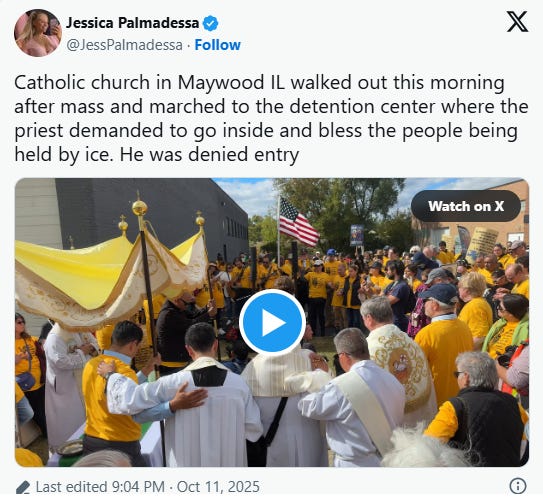
This lethal combination of Christian rhetoric with leftist activism permeates all modern Christian institutions, whether mainline Protestant churches or the “He Gets Us” campaign, funded by the heavily Evangelical Green family, who own Hobby Lobby. No level of inter-denominational feuding changes the fact that Christianity itself is in crisis.
Online PaganBros, using a combination of SparkNotes Nietzsche and Reddit Viking LARPing, often point to these facts to claim that Christianity itself is a force of the Left, but Raspail pushes against this narrative. He is a Catholic in the style of Francisco Franco, Hernan Cortes, and the Crusaders, not the post-Vatican II liberal clerics his story depicts. These modern humanitarian Christians, he makes clear, are traitors to authentic Christianity.
In the book, this perspective is voiced by the Belgian Consul, who seeks to prevent the departure of the migrant fleet from the Ganges. Speaking to the Bishop of the Ganges, who organizes and facilitates the fleet, the Consul declares:
You make for a fine Roman Catholic bishop! There you are, a mercenary for the pagans now… And to what do you bear witness? Your faith? Your religion? Your Christian civilization? No, none of that. You bear witness against yourself, like the jaded Westerners you are. - Ch. VI
He decries the values of humanitarianism, pointing out that they arise, not from authentic Christianity, but “Deplorable, vile, hateful pity! Or what you call: charity, solidarity, universal conscience… but when I look at you, all I see is contempt for yourself and what you represent.” Invoking the same ordo amoris which Vance cited (a term coined by Thomas Aquinas), he asks the bishop, “Is not unbridled charity a sin against oneself?”
Is It Over, Anon?
The picture Raspail paints of the future hardly encourages the reader, but the message is not a black pill; it is an exhortation. The West has not yet fallen, though it teeters on the edge. Our problems are not outside our power to solve, if only we can muster the will.
Several recent examples show what is possible. In an American context, violent crime reached an all-time high in the 1980s, but declined by 26% during the eight years after then Senator Joe Biden’s 1994 Violent Crime Control and Law Enforcement Act drastically increased funding for prisons and law enforcement while pushing for harsher sentences. Mayor Rudy Giuliani turned New York City into a clean, peaceful metropolis in the 2000s through “Broken Windows Policing” and “Stop and Frisk.” More recently, around the world, Nayib Bukele managed to turn El Salvador into the world’s safest country by simply arresting gang members and throwing them into a giant prison. At the same time, Denmark’s Social Democratic Party government has completely closed its borders and begun a process of remigration.
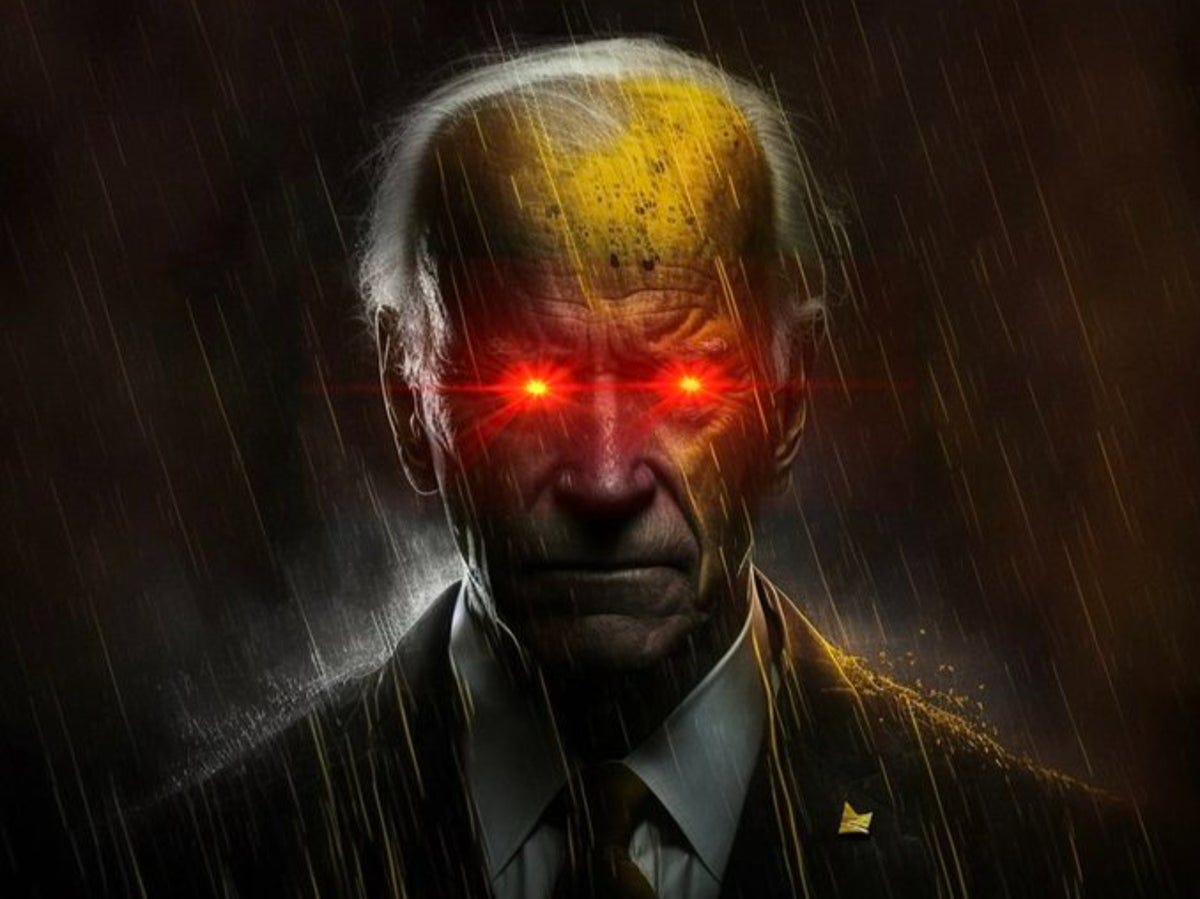
All of these efforts have faced backlash, in most cases on racial grounds, even though they are not the work of right-wing extremists. Biden was a “blue dog” Democrat, and got the bill signed under a Democrat president. Giuliani was a moderate, socially liberal blue-state Republican. Bukele began his career as a representative of El Salvador’s center-left party, and the Danish Social Democrats occupy the same position on the political spectrum.
The difficulty is every effort to restore order and defend civilization in the West is inevitably met with the same moral criticisms and name-calling. Enforcing laws requires the use of state violence and can disparately impact different racial groups; therefore, they are “fascist” and “racist” and basically one step away from Auschwitz. The whole international human rights apparatus, including supposedly Christian and Conservative organizations, will use any appeals necessary to shame normal people and cause them to doubt.
As Bennett's Phylactery of EXIT Group wrote last week, one of the big problems the Right faces is that there is no counternarrative to the human rights consensus: “It isn’t even, exactly, that they’re afraid of being called a bad person: they’re afraid of feeling like a bad person. They have no way to confront these facts within the moral frame they were raised with.” Even many hardened right-wingers are tormented by Nietzsche’s “bad conscience,” unable to truly break with humanitarian ideology.
Many conservative Catholics, for example, are unwilling to criticize a Church hierarchy which obviously opposes the interests of Western Civilization, with one self-described “fascist” even calling for the maiming of right-wingers critical of Pope Leo’s immigration stances.
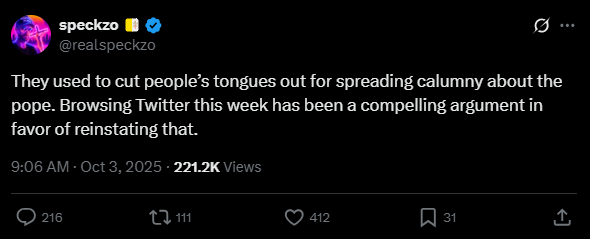
What the West needs is a clear internal sense of righteousness which can justify use of force to ensure its own survival. French conservative historian Domique Venner called this sense “the horizon of war,” without which a civilization will commit suicide.
This new narrative cannot rely on existing religious institutions, but can call on religious ideas. In the Catholic context, in addition to Aquinas’s ordo amoris, important arguments include Pope Pius XI’s Mit Brennender Sorge, which referred “race, or the people, or the State, or a particular form of State, or the depositories of power” as “fundamental value[s] of the human community,” and Pope Benedict XVI’s (the real one, not the fictional one) 2006 Regensburg Address, where he explained the codependence of Christianity and Western Civilization, writing that “Christianity, despite its origin and its important development in the east, has ended up taking on its historical character in Europe.”
From a purely Biblical perspective, many scholars have pointed out the Biblical defense of national identity, most famously Israeli scholar Yoram Hazony in The Virtue of Nationalism (2018). Further, legal theorist Carl Schmitt, writing in his 1932 The Concept of the Political (summarized well here by Charles Haywood), showed how Christ’s command to “love thy enemy” refers to personal enemies (inimicus) and does not prohibit state violence against public enemies (hostes).
The Right also can and must, like Enoch Powell, draw on non-religious sources to justify its own existence, especially the inheritance of classical Greece and Rome. Homeric warrior myths, the legend of Horatius defending Rome from invading hordes against all odds, and the conquering figures of Alexander and Caesar should serve as inspiration. Meanwhile, great modern European commentators on the classical world, including Schopenhauer, Nietzsche, Spengler, Venner, and Strauss, should provide the basis for a new right-wing philosophy, distinct from the broken conservatism of the last century.
The Camp of the Saints shows what the world will look like if the West continues down its current path, without a belief in its own right to continue; Raspail’s challenge is to find a way to renew a society whose institutions, traditions, and beliefs have been corrupted. Only with a clear-eyed view of this crisis will the Right summon the moral courage to do what is necessary.