
On Drones and Pseudo-Events
Something not happening while nothing ever happens.

New Jersey has been invaded by aliens.
Order always opts for the real. In a state of uncertainty, it always prefers this assumption…But this becomes more and more difficult, for it is practically impossible to isolate the process of simulation; through the force of inertia of the real which surrounds us, the inverse is also true (and this very reversibility forms part of the apparatus of simulation and of power's impotency): namely, it is now impossible to isolate the process of the real, or to prove the real.
- Jean Baudrillard, Simulacra and Simulation
Sometimes things happen. For the most part, nothing ever happens. ‘Nothing ever happens’ is common. The best application for ‘nothing ever happens’ is when something might happen. Putin or Biden say the n-word (nuke), but then the wise chuds on X go all-in on ‘nothing ever happens.’ They are usually right. Sometimes, something happens. Assad is gone. That was a ‘nothing ever happens’ for over a decade.
But, more weirdly, sometimes nothing is happening, but we all act like something is happening. This is the nature of a pseudo-event or non-event. The pseudo-event is an event that may or may not have happened, but it is covered as if it did happen. News and social media collectively hallucinate a shared perspective of an event that is not happening or happening in a way distinct from what the hallucination portrays.
Think about the early days of COVID-19. Starting in March, the media narrative told us that we were living out the plot of Contagion (2011). Yes, there was a virus. Yes, people died. However, there was a complete mismatch between the media-induced hallucination of the event and what was happening. In the summer of 2020, I traveled to Oklahoma City and the northwest suburbs of St. Louis. In both cases, I found people living in the real world. In Austin, Texas, however, the pseudo-event had become the event. The simulation had contaminated the real world, where daily life had transformed to accommodate the narrative.
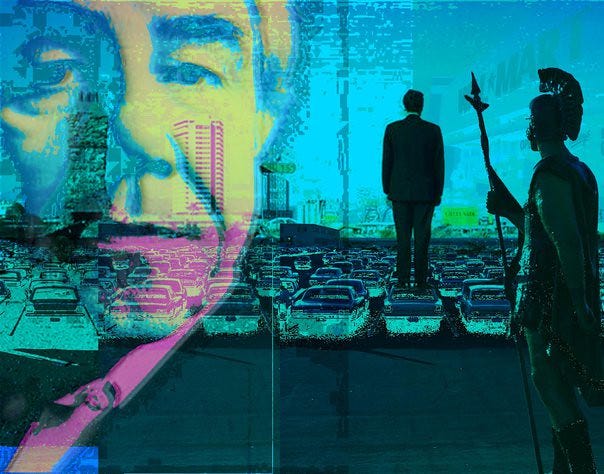
Drones are invading New Jersey. This is a pseudo-event. Nothing is happening.
But we saw the videos on social media! There must be a dirty bomb somewhere in New Jersey, and now the government is trying to find it, like le epic spy movie!
According to the joint statement from the DHS, FBI, FAA, and Dod, “the sightings to date include a combination of lawful commercial drones, hobbyist drones, and law enforcement drones, as well as manned fixed-wing aircraft, helicopters, and stars mistakenly reported as drones.” They identified nothing anomalous about the sightings. Funny how in all the drone videos, they mostly have FAA-compliant lights.
But everyone talked about it. And people kept reporting sightings to government authorities. The puzzled government authorities promised to investigate, and then they became even more puzzled because nothing was going on.
Strange instances of nothing happening but still happening as a pseudo-event are unsurprising symptoms of our age. The murkiness of our simulation media environment becomes navigable with the insight of Jean Baudrillard. He writes in Simulacra and Simulation.
Thus all hold ups, hijacks and the like are now, as it were simulation hold ups, in the sense that they are inscribed in advance in the decoding and orchestration rituals of the media, anticipated in their mode of presentation and possible consequences. In brief, where they function as a set of signs dedicated exclusively to their recurrence as signs, and no longer to their "real" goal at all. But this does not make them inoffensive.
Our media environment runs on a symbolic system. It is like an operating system. It sets the rules and determines what information gets to whom and how. It can be changed and updated, like any operating system. Let us say you are programming a way to calculate someone’s taxes owed into your operating system. The user will input their income, and the computer returns the taxes owed. You could brute force this problem, creating an extensive dictionary of all possible incomes and the corresponding taxes. This would take up many lines of code and be quite cumbersome! Alternatively, you could write an algorithm that will simply calculate the taxes owed after income is inputted. One time.
This is what Baudrillard is describing. Our simulation has an algorithm for dealing with certain kinds of events. When a hold-up or hijacking happens, the media responds predictably. The story is already written, and the conclusion is already known. These algorithms are out there for those with eyes to see. This is water. Here is another one:
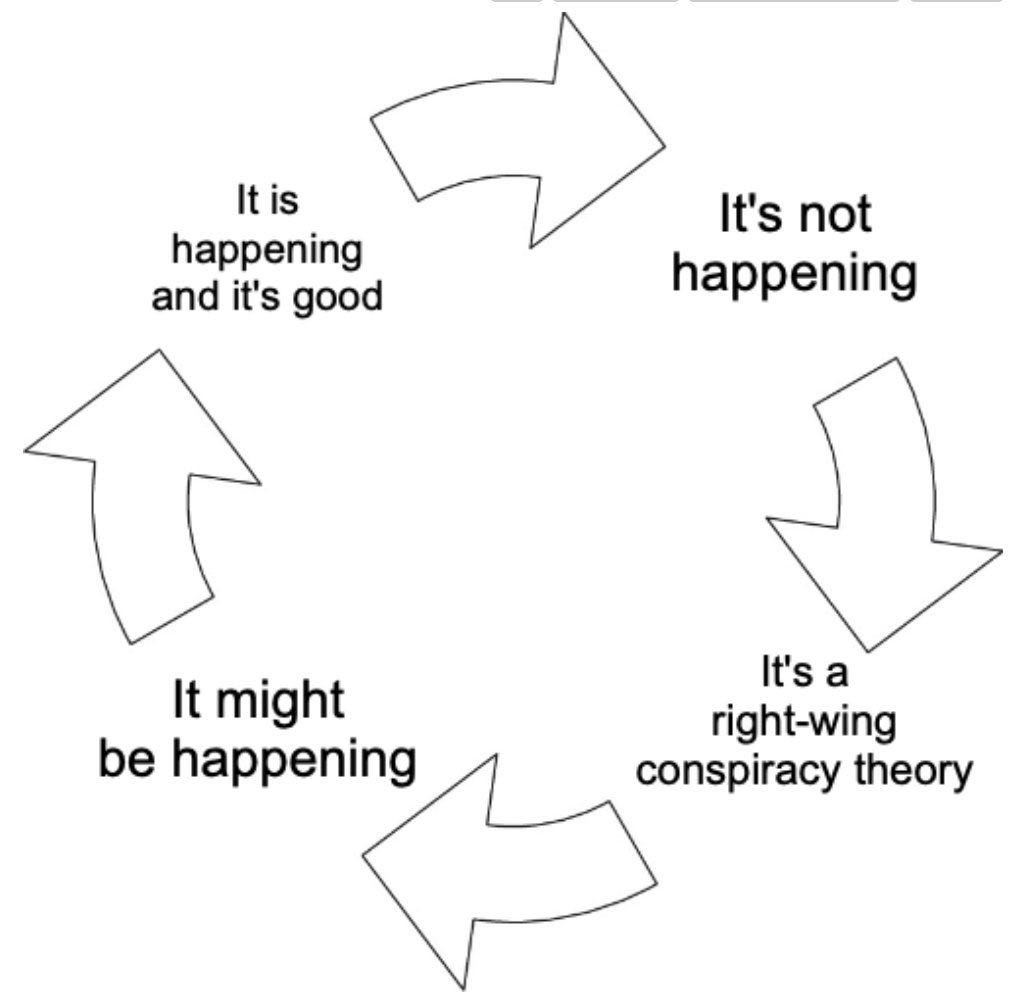
But the signs serve the presentation of the signs, not the event itself. The signs are about the algorithm; they are not about the input. The content is inconsequential. The medium is the message. Baudrillard continues:
On the contrary, it is as hyperreal events, no longer having any particular contents or aims, but indefinitely refracted by each other… that they are precisely unverifiable by an order which can only exert itself on the real and the rational, on ends and means: a referential order which can only dominate referentials, a determinate power which can only dominate a determined world, but which can do nothing about that indefinite recurrence of simulation, about that weightless nebula no longer obeying the law of gravitation of the real - power itself eventually breaking apart in this space and becoming a simulation of power (disconnected from its aims and objectives, and dedicated to power effects and mass simulation).
Hyperreal events (pseudo-events) are not about anything specific. Instead, they proliferate and create a massive web of simulation. News stories are written about news stories about news stories about news stories… there was probably an inciting event in there somewhere. Most tweets are about tweets, which are about tweets, which are about other tweets.
Referential orders, which are concerned with real things, cannot deal with simulation. The simulation infects the power structure, turning it into the simulation of power. The King of England “owns parliament,” or at least he is supposed to. But he does not have that power. He has the simulation of that power. In America, our bureaucracies do stuff. For the most part, this stuff seems to be mouse-wiggling as a remote worker. And then you get an email about some drone sightings.
This is how nothing happens.
If you enjoyed this piece, please leave a LIKE and SUBSCRIBE.
For 15% off NicNac nicotine lozenges, use code AF15XSAVE15 at nicnac.com/drmonzo.