
Setting the Record Straight on Neoreaction
A response to The New American's piece on Dark Enlightenment

In October, my friend Andrew Muller published ‘The Dark Enlightenment: Captivating Youth to Embrace Monarchy’ in the New American. This essay responds to Muller's article, in which he seeks to illuminate the influence of the “Dark Enlightenment,” also known as Neoreaction.
Originally promulgated by Curtis Yarvin (under the pen name Mencius Moldbug) and Nick Land, neoreaction is an antiliberal philosophy that aims to recover and update pre-enlightenment modes of political thought. It recognizes that progressivism has been a complete failure, and an alternative is necessary to restore functional government and human flourishing, a statement that any conservative would likely find agreeable. The disagreement arises in the specifics of neoreactionary complaints and alternatives.
This essay addresses Muller’s primary criticisms of Neoreaction and clarifies his descriptions of it. Furthermore, it will assess the comparative efficacy of Neoreaction and Muller’s Constitutionalism in addressing the problems of modern America. Finally, this essay deconstructs the mythical understanding of the American founding that underpins Muller’s article.
In the endnotes, I have included my own summary of Muller’s article to avoid straw-manning it.1 Additionally, I asked him a few on-the-record clarifying questions.2

What is Neoreaction?
Muller makes four core claims about the Dark Enlightenment:
It holds that society should return to things that the Enlightenment overcame.
It holds that democracy is bad.
It holds that society would be better governed by a monarch/CEO/dictator than by the current American system.
It holds that AI should be integrated into the government.
This section will address all four of these claims about Neoreaction and explicate what Neoreactionary authors, especially Yarvin and Land, have stated on these subjects. Muller’s claims and evidence seem to be based predominantly on interviews with Yarvin rather than on his writings. While many of the broad strokes in the New American article are close to accurate, Muller’s account merits clarification.
The essence of neoreaction is not perfectly captured by these four claims, but it gets close. Land states in ‘Neoreaction (for Dummies)’, the first consensus of neoreaction is that “all neoreactionaries define themselves through antagonism to the Cathedral, and the Cathedral is the self-proclaimed consummation of Enlightenment rationalism.”3 Muller gets this right enough, stating that neoreaction wants to overturn aspects of the Enlightenment. However, he misses the second part.
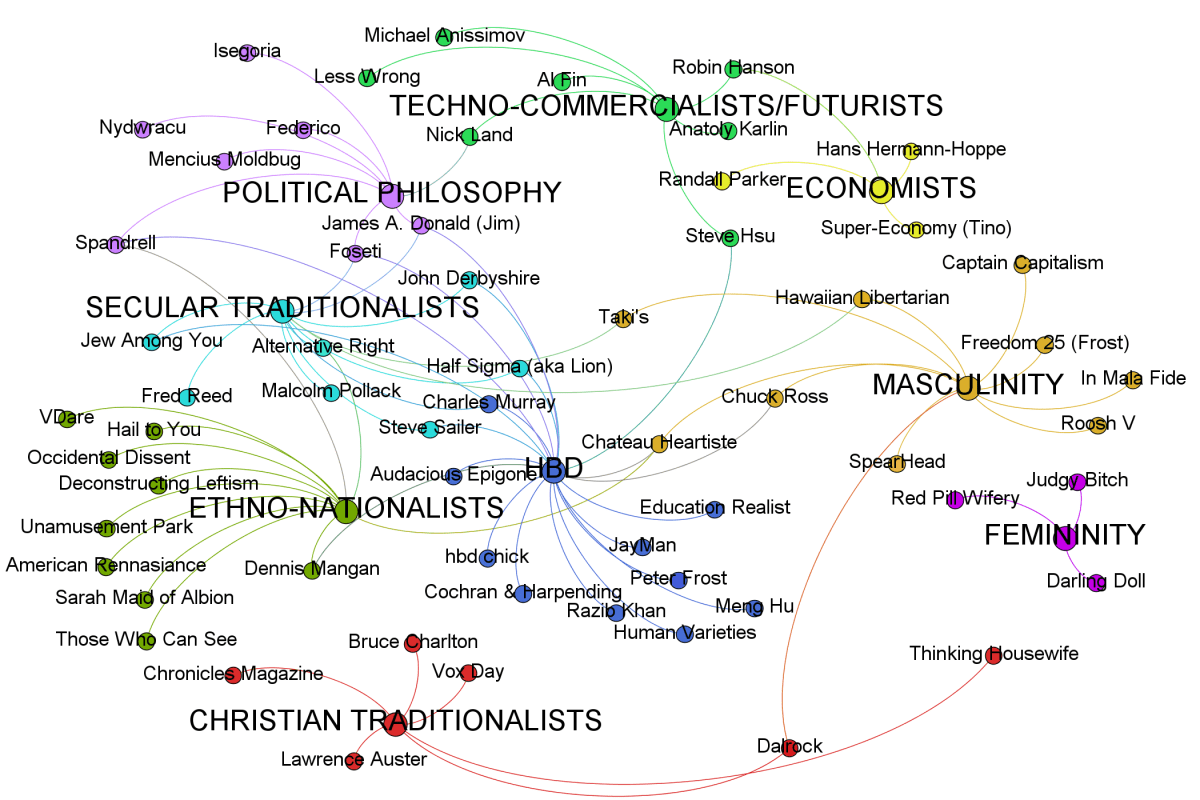
The normative causes of neoreactionaries, at least in the 2010’s, could be split into three predominant camps: religious traditionalists, ethno-nationalists, and techno-capitalists. Among these camps, the alternative to the Cathedral looks wildly different. They do, however, “share a fundamental aversion to rationalistic social reconstruction, because each subordinates reason to history and its tacit norms – to ‘tradition’ (diversely understood).”4 Muller fails to account for who is (neo)reacting and why. These omissions are not necessarily criminal, but they are important to flesh out the subject matter of his piece.
In ‘The Reactionary Consensus’, Nick Stevens gives a more robust description of the neoreactionary consensus.5 These are descriptions of reality as the neoreactionary sees it, and as the Cathedral undermines or ignores:
Hierarchical social structures: Hierarchy is not only not bad, but natural and absolutely essential to the proper functioning of any social structure;
Sex Realism: Sex differences are real, are ordained by nature or nature’s god or both, and we ignore them at our peril;
Race Realism: Race and group differences are real, are ordained by nature or nature’s god or both, and we ignore them at our peril;
Memetic Realism (“Deep Heritage”): Traditional folkways tend to be real, i.e., non-ideological, and naturally arising adaptations to social realities, which therefore represent pretty good (at least) local solutions to very (or intractably) complex problems;
Economic Realism (later badly dubbed “Microeconomics” and we still await a name for the phenomenon): In any economy where an absolutely fixed supply of (properly divisible) money is deemed impossible or impractical, there is ipso facto a con game going where the issuance of money has itself become a political weapon;
(Hyper)Federalism: Local optima rarely scale well; subsidiarity; the right of exit must be guaranteed;
Social Justice: If social justice is anything at all, it is merely justice;
Democracy: The best and brightest of any society were ordained by nature or nature’s god or both to lead. Expansion of the franchise beyond that natural aristocracy is tragicomically foolish;
Politics: Defined as competition for parcels of power over unrelated others, usually as a means of redistributing wealth, politics is rightly minimized in any sane society.6
This should provide clarity. Neoreaction, at its core, holds that the Cathedral is the apex of the Enlightenment, and the Cathedral ignores and/or actively suppresses a multitude of accurate and important observations about reality, the accurate observance of which are precursors to good and functional governance.
The Enlightenment
Anomaly UK, a now-defunct neoreactionary author, described the thing that neoreaction is reacting against in the following way:
For five hundred years, there have been attempt to reorder human society on the basis that hereditary privilege, and many other kinds of inequality between humans, are unjust. Reformers have attempted to alter systems of government and other institutions of society with the goal of reducing or eliminating these injustices.
These reformers have consistently underestimated the difficulty of getting people to cooperate in a society. The intellectual techniques of science and engineering that produced miracles in terms of manipulating the natural world, have, time after time, failed catastrophically to improve the lives of humans through changing government and society.7
In many respects, this gets to the essence of the Enlightenment. The Enlightenment privileges reason over all else. Some stragglers were able to draw faith across the doorstep, but this contradiction gets eviscerated over time. Reason cannot be supreme while miracles happen. To the Christian, Christ is God incarnate; specifically, He is the Word of God, the Logos. He is the Divinity of reason and rationality. He is also one component of the Trinity. I will dodge the headache of trinitarian parsing here to emphasize that reason is good, but not everything. Faith and unrelenting reason coexisted perfectly for St. Thomas Aquinas, a pre-Enlightenment thinker. The Enlightenment means that the light of reason got brighter than it was for Aquinas, and one must wonder if the enlightbulb can handle this much wattage.
Some truths about reality cannot be found through reason alone. Attempting to rely on reason alone can lead to madness or worse. Reason is Hume denying causality can ever be known. Tradition is being a normal person who knows things cause other things. Tradition is doing things because that is the way we have always done them. There must be a reason we have always done them. Enlightenment reason is: this tradition is in the way of something I want to do, so I can use linguistically contingent algorithms to prove that these Traditions violate some sort of truth we hold to be self-evident.
Of course, traditions must sometimes be updated, but updating a tradition is a natural, somewhat Darwinian process that tends toward the social optimum. This is distinct from rationally-based societal engineering, which does not seek to update but to re-create entirely. The Enlightenment was not a purely political event and coincided with the early stages of mechanical construction and with Newton’s new mechanical model of the physical world, in which God is a watchmaker. This mechanical perspective was also applied to government. The American Founders designed a new government, taking a mechanical approach to ensure that the parts balanced one another and would remain balanced in the future. The mechanical-social-engineering approach is a downside to the Enlightenment that neoreactionaries decry. It is akin to the problem of central planning in the economy. More on the specifics of the American system later.
Land describes the Enlightenment in the first two paragraphs of The Dark Enlightenment:
Enlightenment is not only a state, but an event, and a process. As the designation for an historical episode, concentrated in northern Europe during the 18th century, it is a leading candidate for the ‘true name’ of modernity, capturing its origin and essence (‘Renaissance’ and ‘Industrial Revolution’ are others). Between ‘enlightenment’ and ‘progressive enlightenment’ there is only an elusive difference, because illumination takes time – and feeds on itself, because enlightenment is self-confirming, its revelations ‘self-evident’, and because a retrograde, or reactionary, ‘dark enlightenment’ amounts almost to intrinsic contradiction. To become enlightened, in this historical sense, is to recognize, and then to pursue, a guiding light.
There were ages of darkness, and then enlightenment came. Clearly, advance has demonstrated itself, offering not only improvement, but also a model. Furthermore, unlike a renaissance, there is no need for an enlightenment to recall what was lost, or to emphasize the attractions of return. The elementary acknowledgement of enlightenment is already Whig history in miniature.
Enlightenment is a process of moving from darkness into light. It is a synonym for Whig-ism and progressivism.
Democracy
Muller’s comments on the Neoreactionary critique of Democracy are, unfortunately, the weakest part of the entire article. So much so that his comments border on a total straw man. He states that he agrees with Yarvin’s view that democracy is bad and cites the Founding Fathers who held the same view. Muller then says that America is not a democracy but a republic. His simple definition of a republic is the rule of law, and of democracy is rule by the mob. The error is that Muller’s definition of democracy should not matter at all in his article on neoreaction. To address neoreaction’s critique of democracy, one must understand what neoreactionaries mean by democracy. Filling in the term with one’s own definition is a prime example of the strawman fallacy. So is the assumption that Curtis Yarvin, who enrolled at Johns Hopkins University at age 15, had simply never heard that America is a republic, not a democracy.
This is all to say, to understand why neoreactionaries critique democracy, it is critical to first clarify what they mean when they use the word. This is pertinent because the neoreactionary critiques of democracy apply to democracy as it currently exists in the United States. Generally, by 'democracy,' neoreactionaries mean that the general population has a say in government. If there is voting, there is democracy. The people directly voting on each piece of legislation, like a parliament with hundreds of millions of seats, would be pretty bad, as Muller and any neoreactionary would agree. But neoreactionaries do not focus on this kind of democracy; rather, they critique representative democracy, which is the norm in the post-Enlightenment Western world.
Land explains, in the first part of The Dark Enlightenment, “‘Voice’ is democracy itself, in its historically dominant, Rousseauistic strain. It models the state as a representation of popular will, and making oneself heard means more politics.”8 He also describes it as the nightmare engulfing the world. Why is that the case?
Land describes the feedback loop that quickly forms within a representative democracy. Democracy is a vector, ultimately aimed at gibs. He describes it as a “fundamentally degenerative: systematically consolidating and exacerbating private vices, resentments, and deficiencies until they reach the level of collective criminality and comprehensive social corruption. The democratic politician and the electorate are bound together by a circuit of reciprocal incitement, in which each side drives the other to ever more shameless extremities of hooting, prancing cannibalism, until the only alternative to shouting is being eaten.”
In Introduction to Unqualified Reservations, Yarvin compares democracy to the tragedy of the commons. When everything is shared by all, it will be poorly managed. A conservative has zero problem seeing this issue when it comes to fighting against universal healthcare and other socialist-lite programs. However, when the government belongs to all people equally, it becomes impossible to govern effectively. Everyone wants to get their slice of the government before others do.
Land echoes the sentiment in TDE.
Democracy might begin as a defensible procedural mechanism for limiting government power, but it quickly and inexorably develops into something quite different: a culture of systematic thievery. As soon as politicians have learnt to buy political support from the ‘public purse’, and conditioned electorates to embrace looting and bribery, the democratic process reduces itself to the formation of (Mancur Olson’s) ‘distributional coalitions’ – electoral majorities mortared together by common interest in a collectively advantageous pattern of theft. Worse still, since people are, on average, not very bright, the scale of depredation available to the political establishment far exceeds even the demented sacking that is open to public scrutiny. Looting the future, through currency debauchment, debt accumulation, growth destruction, and techno-industrial retardation is especially easy to conceal, and thus reliably popular. Democracy is essentially tragic because it provides the populace with a weapon to destroy itself, one that is always eagerly seized, and used. Nobody ever says ‘no’ to free stuff. Scarcely anybody even sees that there is no free stuff. Utter cultural ruination is the necessary conclusion.9
Austin Economist Hans Hoppe has had a tremendous influence on many in the neoreactionary space, especially with Democracy: The God That Failed. Hoppe makes an economic argument that democracy (i.e., any political system in which the common people have a say in government) tends to encourage high time-preference behavior. In a democracy, both constituents and elected officials are more interested in short-term gains than in long-term ones. This creates a degenerative tendency in which everyone seeks to use the government as a means of plunder.
Ironically, this is the only thing the U.S. Congress seems capable of delivering. The founders intentionally made Congress inefficient so as to prevent legislative overreach. Because of its inefficiencies, representatives must carefully choose what to deliver to their constituents. Sometimes this is free stuff! Other times, it is work the voter still must do, but it is made more easily available. Most bills passed through the House and Senate are hundreds, and sometimes thousands, of pages of simply this.
A representative democracy tends towards this state, regardless of where it starts. Elections are a prisoner’s dilemma, in which competing candidates can cooperate and agree to self-limit, as in the U.S. Constitution. But they could also cheat and tell their constituents they are going to see about cutting through all that old stuff and getting some free healthcare flowing. Cheating is more likely to get the candidate elected.
This should provide some clarity on what the neoreactionaries are critiquing. They did not aim at the American system and missed, as Muller insinuates. They are critiquing the system of government established by the U.S. Constitution and demonstrating its lack of safeguards to prevent against the specific problems faced today.
Before beginning the next section, though, it is necessary to clarify what we mean when we say “good government”. Yarvin does a nice job of collapsing the weird ethereal distinction between a government and a company. Both of them are ultimately corporations. Both are groups of humans, organized and employed to complete goals. In Chapter 4 of Gentle Introduction, Yarvin states:
For me, quality of government comes in two dimensions: responsibility and authority. Both qualities are monotonically positive. There is no Goldilocks about them. A government cannot be too responsible or too authoritative.10
These are good metrics of government quality. A government should have clear goals and the means to achieve them. The collapsed distinction between company and government is useful here, but more on that in the next section. First, it is necessary to demonstrate how democracy (or a Constitutional republic, or a representative democracy, or whatever you want to call the normal mode of government in the West), fails at both of these goals.
The failure of responsibility is clear and obvious in the American system. The above-described degenerative nature of electoral politics and the nth-order effects of that degeneration have resulted in a state incapable of performing one of its most basic functions: immigration enforcement. Even when a President is overwhelmingly elected on a platform that promises to restore it, the task is still colossally difficult. Even though it is technically easy. But the government is not responsible enough to simply let Erik Prince and Peter Thiel run wild on the border. Additionally, many American cities have decayed into crime and terror. Detroit was once called the Paris of the West, and St. Louis was Rome. These labels are laughable now. “City” means high murder rate. And yes, it would be unconstitutional for the President to fix Chicago. The Supreme Court said so, and the Constitution allows them to say so.
The second question, the question of authority, is also a point of failure for Enlightenment government. The separation of powers runs directly contrary to state authority, and the American founders did so deliberately.
Yarvin states:
There is no conceivable balance between competing authorities; they will fight until one kills the others. . . Of course, divided authority tends to be quite popular among those who divide the authority. Power is fun, and power shared three ways creates more total fun than power held by one. Note also the entropic quality of division: it is much easier to divide than to reunify.11
The division of authority is evident in the ability of all Americans to vote and in the separation of powers as enumerated in the Constitution. The separation of powers is an attempt to make the state responsible to a third party, but the third party is another part of the state in this instance. Any organization should be accountable; it creates strong incentives. This particular form does not create strong incentives. Yarvin continues:
The great error of libertarians, as well as many liberals, progressives, etc., is to suppose that the weaker the State is, the freer its subjects are. The opposite is very nearly true. A weak government is a large government—and the smaller the State, the freer its subjects are. Every time you weaken your government, you give it another excuse to become larger.
Essentially, big government is big because it is constantly competing with itself. . . In the US, not individuals but agencies of the State compete for power and importance. Each seeks to expand its own impact, budget, and personnel. If USG, tomorrow, were to find itself operated as a single authority, it would set quite a number of live coals under quite a number of superfluous agencies.12
What is the solution? How does one attain a responsible and authoritative government?
Monarchy
Why does the government not run everything? Why do other corporations exist at all? A communist says, so true! A conservative knows it is because the government is astoundingly inefficient. Have a small sip of von Mises, and the reason why is clear: the profit motive. Private corporations must deliver profits to their shareholders to continue existing. This creates a strong incentive to have good governance.
The market is a process of Darwinian selection for good governance structures. Companies that can deliver to shareholders prosper, whereas those that cannot fail. There is skin in the game, and bad decisions are punished unrelentingly. Consequently, companies are run by a single CEO. The CEO is accountable to shareholders and provides products or services that consumers are willing to pay for, making the company profitable.
Speaking of skin in the game, any military has a clear chain of command. The consequence of mismanagement is much harsher here. Instead of being broke, it is being dead. Militaries cannot afford anything less than a hierarchical org chart in which decisions come from the top down, and people obey.
Muller states, “Historically speaking, the concentration of power in one individual has always led to greed, corruption, and abuse.” He also says, “Only a bottom-up, citizen-led revival will turn the tide.” Of course, he is speaking about government structure, but what is so mystically different about governance when it is within the government, instead of in another kind of corporation or a military (which, come to think of it, is part of the government)? When the pressure is on, singular leadership rises to the top because it is the only way to achieve decisive authority. The concentration of power in one individual has not historically “always led to greed, corruption, and abuse.” When Elon Musk took Twitter private and assumed absolute control, he rooted out significant corruption and abuse, only possible because of his full executive authority. He did not turn Twitter into a bitcoin mining virus. This example is especially illustrative because such power to root out corruption was expected when Elon showed up with DOGE. He quickly discovered that such power does not exist anywhere in the federal government, because it is separated. Instead of rooting out corruption, corruption was given a haircut.
Any military that relied on bottom-up, citizen-led decision-making, if one ever existed, was likely destroyed so completely that no history book has recorded it.
Hans Hoppe argues for monarchy in Democracy, claiming that the incentives that lead to democratic degeneration do not exist in a monarchy. In a monarchy, Hoppe argues, the state is the private property of the monarch, and he has an incentive to grow its wealth over the long term. If it is a hereditary monarchy, he is incentivized to do so for generations to come. His revenue comes from taxation, so he wants to ensure he does not tax too much and that his taxes and decrees do not harm his nation's long-term well-being.
A monarch has a profit motive, so he governs well. The American Constitutional Republic clearly has no profit motive. It seems to have a deficit motive. It is not structurally impossible to transform the United States government into something with a profit motive, though. Yarvin offers a few ideas in his writings, but they will not be discussed in detail here.
Land states:
Ultimately, however , if after all these centuries of trying to improve society based on abstract ideas of justice have only made life worse than it would have been under pre-Enlightenment social systems, the time has come to simply give up the whole project and revert to traditional forms whose basis we might not be able to establish rationally, but which have the evidence of history to support them.13
“Pre-Enlightenment social systems” sounds like mud-and-manure streets on first read, but consider that the neoreactionaries are not arguing for the economic and technological systems of the pre-Enlightenment era. In reality, the entropy of democracy has been steadily offset by the technological boon, just enough for America to avoid total implosion. Consider contemporary nondemocratic countries with similar levels of economic and technological development. China, Saudi Arabia, the UAE, Qatar, and Singapore all reject democracy in favor of something more decisive. They all also have profoundly lower homicide rates than the United States, with Singapore and Qatar boasting homicide rates 1/58th of America’s. Qatar is a literal monarchy, and Singapore is a one-party state. One of the most basic government functions is to prevent citizens from killing each other. Nondemocratic society + modern technology = riding the bus without getting stabbed. Of course, this is simplistic, but it is far more complex than Muller insinuates.
Hitler. I mean, what if the government starts killing people out of nowhere?
Maoism, Stalinism, and Communism generally are natural outgrowths of the Enlightenment project. They are the faith in man's ability to rationally reconstruct the social structure and to ignore all constraints. There is a through line that runs from Rousseau to the European socialist movement, which exploded into the hell of Communism last century, which I wrote about here:

But Hitler was not a Communist. Thankfully, since everyone thinks of Hitler first when they think about changing the government, Yarvin addressed the HQ in multiple places. The obsession with Hitler is weird, but there is a reason for its existence. This will be covered later. Yarvin states:
However, in the terminology of government, this system would be described as an absolute dictatorship, or (once) an Oriental despotism, and you consider it the most dangerous possible design—one certain to practice sadistic, Kafkaesque mass murder. The salient examples, of course, are Stalin and Hitler.
There are quite a few mistakes in this perception, but one of the main ones is to take examples from outside one’s own tradition of government. In the post-WWII era, everyone’s tradition of government is the Anglo-American tradition, and when we think of absolute personal rule we should be thinking of Elizabeth I. (If you’re going to argue that Elizabeth and Hitler were truly comparable, I’d like you to start by showing me the Nazi Shakespeare.)
Hitler and Stalin are abortions of the democratic era—cases of what Jacob Talmon called totalitarian democracy. This is easily seen in their unprecedented efforts to control public opinion, through both propaganda and violence. Elizabeth’s legitimacy was a function of her identity—it could be removed only by killing her. Her regime was certainly not the stablest government in history, and nor was it entirely free from propaganda, but she had no need to terrorize her subjects into supporting her. Not so the dictators of the democratic era, each of whom could have been removed by a combination of their subordinates, and depended absolutely on personal mass popularity to avert this fate. And killing or incarcerating opponents is a pretty obvious way to maintain one’s popularity.
Finally, the desire for CEOism or some specific form of monarchy is not a unified neoreactionary perspective, though Yarvin tends to emphasize it.
AI
This section will be very short. Muller claims that some neoreactionaries think the government should use AI. He quotes Joe Allen from War Room, who warns of algocracy. He then states that neoreactionaries wish to make the United States into an AI monarchy, or something like that.
Once again, neoreaction is not a unified ideological system with a proposed structure. It is the observance of constraints baked into reality, and the recognition that the post-Enlightenment system rejects or actively suppresses these to the detriment of human flourishing.
Raising a red flag over the government using AI is like raising one over the government using the internet. The United States government is already quite dysfunctional compared to other corporations. Imagining the government without AI in 2030 is like imagining the government without email in 2015.
Regardless, I have written on AI elsewhere, and I do not see this section as a core critique of neoreaction. Muller’s only connection is Thiel and Yarvin having a connection, and Yarvin’s claim that Thiel is fully enlightened, as well as:
The ties between the Dark Enlightenment and Big Tech data companies are worth noting. Peter Thiel’s Founders Fund has partnered with Andreessen Horowitz to invest $1.1 million in Urbit, a decentralized computing system created by Yarvin.
This is a weak connection at best, at least until one realizes what Urbit is. The Urbit project and its goals make Linux look like a fascist dictatorship.
Enlightenment Liberalism vs. Neoreaction
To discuss a solution, there must be clarity on the problem. The primary problem that Muller identifies and resonates with Neoreactionary thinkers is the deep state. This results in bad governance. It is not amenable to human flourishing. Instead, it creates entropy, resulting in a gradual buildup of dysfunction and occasional eruptions of major problems. The latter becomes more frequent and larger over time.
The deep state is similar to but slightly distinct from “the Cathedral.” Curtis Yarvin described the Cathedral as the spontaneously emergent complex of journalism, academia, NGOs, activist organizations, and other truth-distributing mechanisms. These are the shapers of public opinion, and they all move in one direction. Yarvin calls it the Cathedral because it functions like a religious institution that disseminates absolute truth to the masses. Land has a similar estimation of the Cathedral, describing it as a theocratic priestly class that enforces progressive, egalitarian, and democratic norms. He states:
The Cathedral is an information system… that is characterized… by a structural inability to learn… [I]t displays a radical deficiency of significant feedback links to the control core. Every apparatus of information gathering occupies a strictly subordinate position, relative to the sovereign Cathedral layer, which is defined exhaustively by message promotion.14
He also describes the Cathedral as a layer on top of the occult government, i.e., the deep state.15 The Cathedral is the shallow state, functioning as the psychological warfare arm of the state, Yarvin says, that is critical to every democracy. The Cathedral and the deep state are both unelected power structures with much overlap. It is up for interpretation where the lines, if any, are drawn.
But the core question is: what problem with the Cathedral/deep state must be solved? The neoreactionary critique is that it obscures and suppresses constraints in the name of rationalist reconstruction of society. A core part of this is the idea that history has an upward trajectory and that progress has occurred. The essence of the problem is that devotion to rationality-driven societal re-engineering leads to poor governance, whereas adherence to natural constraints can lead to good governance and prosperity. This section explores some solutions proposed by neoreactionary authors.
Muller’s objection to the Cathedral/deep state seems to be that it is unaccountable to the American people, and that this must be addressed by restoring and following the Constitution. The neoreactionary objection to the Cathedral/deep state is that it tends toward entropic, degenerative governance. Neoreactionary solutions are diverse because they are not an ideology; this section will focus on neocameralism as the neoreactionary solution, as it roughly corresponds to the solution Muller critiques in his article. The remainder of this section will evaluate Müller’s Constitutionalist solution against neocameralism in its ability to solve the impacts of the Cathedral.
The Liberal Solution and Its Discontents
Muller argues that the US Constitution should be the chief governing document, the law of the land, the charter of the state, within the United States. Fortunately, that is already the case. In a way, Muller is arguing for the status quo. He is arguing that the US should be governed by its Constitution. It certainly has not been repealed, but here we are. But that is a bit of a strawman; I am being cheeky. Even so, to deny that you are advocating the status quo whilst also advocating for the same governing documents as the status quo is no true scotsman fallacy, akin to “That wasn’t real Communism.” Real liberalism has not been tried because it degenerates instantly.
In all seriousness, the historical record has proven that the US Constitution is wholly incapable of preventing the problems America currently faces. It is ineffective in its aim of limiting government. Muller states that the American founders designed the Constitution to limit government, but they did not do so well. The purpose of a system is what it does, not what it was intended to do. The distinction between two states is clear in software design; it does not matter what the author intended the code to do if it causes a stack overflow. The Constitution is the state's program and suffers from severe memory leaks, numerous unhandled edge cases, and is written in COBOL.
Muller says that elected officials are “bound by the chains of the Constitution.” Are they? Many of the problems that Constitutionalist Conservatives decry are downstream from elected officials acting outside the Constitutionally enumerated bounds of their offices. This complaint is so common that it is impossible to argue that the Constitution binds them. He quotes Washington, who says that whenever elected officials act contrary to their interests, they “undoubtedly will be recalled.” This does not seem to be the case either. Of course, there is disagreement over what the people's interests are. This is why there are two political parties. People naturally tend to vote for their own self-interest. This is the nature of democracy, as outlined in the above section.
Muller’s solution is not the Constitution alone, though. He knows the Constitution is still the law of the land. The problem is that the people vote for representatives who do not care about the Constitution. The solution is to educate the American people to be virtuous and to understand the first-, second-, and fifth-order effects of the slightest deviation from Constitutional constraint. Once educated, the argument implies, the people will be wise enough to select politicians who follow the Constitution. This education must continue forever. Muller’s solution relies on ensuring that enough Americans get it and that the infrastructure exists to sustain this level of education for hundreds more years.
The problems with this solution are threefold. First, the current educational infrastructure (the Cathedral) runs in the precisely opposite direction and with much more power. Second, it relies on core Cathedral dogma. Finally, the mass-education solution runs directly against the natural dynamics of democracy.
In a society where people have a say in government, being able to shape how people think about government and elections is invaluable. Whenever the people control the government, controlling the people is a great way to control the government. This is the essence of the Cathedral: a truth-manufacturing machine. It creates pleasant narratives and specialized agitation to get the American people to vote for itself. Of course, “it” has no agency and is an emergent, dynamic process of self-seeking people within and outside government. It specializes in telling people what to think, owning public education, academia, and the media. Muller’s solution relies on educating enough people about the Constitution's merits so that they will vote only for representatives who follow it. This will hypothetically be done through conferences, pamphlets, homeschooling, and other means.
What is the time horizon for restoring sound governance under this plan? Whatever it is, it seems long because Muller and those who share his reverence for the Constitution must educate people more effectively than the US government managed to convince everyone to go on lockdown in 2020. That is a tall, tall task. I do not want to be mean, but a strategy that banks on successfully educating the majority of America about the Federalist Papers more efficiently than the team that did MKULTRA and prints every textbook can get them to be passive on the matter is frankly laughable. I fear that Muller’s solution relies more on the idealist nostalgia for the American founding than on any feasible strategy. The Cathedral does not need to convince the people that the Constitution is bad. The idea of the Founding and the Constitution is not a danger to the Cathedral, so much so that public schools teach them to all schoolchildren. It may not be the best system, but that leads to the next problem with Muller’s solution.
Land states in The Dark Enlightenment:
The central dogma of the Cathedral has been formalized as the Standard Social Scientific Model (SSSM) or ‘blank slate theory’. It is the belief, completed in its essentials by the anthropology of Franz Boas, that every legitimate question about mankind is restricted to the sphere of culture. Nature permits that ‘man’ is, but never determines what man is. Questions directed towards natural characteristics and variations between humans are themselves properly understood as cultural peculiarities, or even pathologies. Failures of ‘nurture’ are the only thing we are allowed to see.16
Only blank slatism could rely on mass education as a solution. Muller’s solution cannot harm the Cathedral because the story of the American Founding is part of the Cathedral's story. It is one of the first revolutionary events in the long chain of revolutionary events comprising the progressive telling of history. It can integrate it easily, since blank slatism was inadvertently baked into the one part of the Declaration of Independence everyone remembers: “all men are created equal.” Sure, Jefferson meant “equal in dignity before God” (he also meant something different by “people”), but that is not what people think when they hear that statement. They hear the progressive interpretation that we are all the same on the inside and that the only factors affecting a person’s abilities are upbringing and education.
But people are indeed different. The average IQ in America is less than 100. Most people are simply following their appetites and consuming various forms of entertainment. They will not wilfully subject themselves to an education in the Constitution. This education in the Constitution must also include a comprehensive education in the Articles of Confederation, the Federalist Papers, and related sources, so that everyone is on the same page about why the Constitution says what it does, lest they inadvertently vote for something non-Constitutional. At worst, the American people are incapable of being educated to such a degree and have no desire to. Even if they can be educated to this degree, they will still have little desire to do so. People have jobs and responsibilities, and also weed and porn. Robust Constitutional theory is either inconvenient or unenjoyable for many. Likely most, likely vastly so.
And finally, it is appetite that rules democracy like gravity. A representative who promises free stuff will always be more appealing than one who says he will be a good Constitutionalist. Even if everyone were mind-wiped tomorrow, except for knowledge of the Constitution, it would not take that many elections for the Prisoner's Dilemma to return to its typical suboptimal state. Someone will try promising free stuff, get elected, and, when it does not work, will not admit that the failure was due to constraints, but rather to all the Constitutionalists around. Free stuff is delicious, being much more appealing to the masses' appetites than the idea of voting for people who will constrain their own power. Congress optimizes for gibs. It is a design bug.
So, in summary, Muller’s plan to defeat the Cathedral is to educate everyone more efficiently than all of the schools, academia, and media can, despite their lack of desire to be educated, and the education must implant a degree of fortitude and certainty that prevents anyone who promises free stuff from turning a single head. And even if we get to this point, what then? Just maintain this level of education forever?
And what does the intermediate process look like? Sure, a conservative would object that aspects of the Cathedral consent manufacturing can be curtailed in the meantime. This has its limits, one of which is freedom of the press. The Constitutionalist view also carries a philosophical allergy to gaining and keeping power, and a love for destroying or distributing one’s own power. The best Constitutionalists in Congress right now are Massey and Paul, total embarrassments for the furthering of America. They also lend credence to the idea that liberal government is ineffective, seeing as that they complained when police cleaned up the nations capitol and drug smugglers carrying enough fentanyl to kill millions were killed without due process.
All of that aside, what does rolling back to the Constitution even look like in modern America? Here is a test: Will these newly elected Constitutionalists survive the repeal of the Civil Rights Act? It is obviously unconstitutional; look at any conservative author writing at the time of its passage. It completely destroys the right to freely associate with whom one chooses within one’s own property. And you, dear reader, have your public education programming in the back of your mind right now, blaring “racist racist racist stop stop stop.” Whoever even proposes the repeal will instantly lose the next election on charges of severe racism and desire to return to Jim Crow. Anyone who votes for the repeal will meet the same fate.
This cannot be a serious solution. I have made a great effort not to strawman but to lay out how this strategy will actually work, and it seems that Constitution restorationists should try to do the same. It will not solve Muller’s problem with the deep state, which is that the people are not in control, because the problem stems precisely from the common people having control in the government in the first place. It will not solve the problem of bad governance either. This solution is at best ineffective, and even if it succeeds, it merely returns us to the status quo.
Neocameralism
Neocameralism is not a word that appears in Muller’s article, but it is essentially the neoreactionary solution Muller attempts to critique. This section will detail what neocameralism is and how it solves the problem of effective governance better than Constitutionalism. This section will then address Muller’s criticisms of Yarvin’s solution.
Yarvin describes neocameralism as a governance system in which states operate as for-profit joint-stock sovereign corporations.17 As I stated in the monarchy section, the idea that the state's organizational structure is wholly unlike that of a private corporation is silly. The government should be treated as a business that aims to maximize shareholder value. Yarvin also describes Patchwork, an international political arrangement in which territory is divided into smaller sovereign sections, each owned by a separate sovereign corporation, thereby ensuring competition among states.18
A neocameralist state (sovcorp) would have shareholders who own equity and control management through voting rights given to them by their equity. Shareholders receive profit when state revenue exceeds state expenditure. This provides a strong incentive to ensure long-term prosperity for the citizenry. Short-cited free-stuff proposals, which are the rule under Constitutional republics, would be useless for sovcorps because they do not benefit the government or its citizens in the long term.
The shareholders appoint a CEO who has undivided sovereign authority but remains bound by his fiduciary duty. Yarvin overcomes many of the other perverse-incentive dangers (going Hitler mode) with cryptographic enforcement mechanisms, such as private keys for decision verification and military oversight.
Residents are customers who enter into rights-protection covenants with SovCorp. They are the customers, so they pay taxes and rent to the corporation for this privilege. These will be optimized for efficiency and long-term gains, thereby avoiding abuse and excess in taxation. Should such a thing arise, exit is a suitable option. Relocate to another sovcorp.
This provides dramatically better management incentives than the status quo or even the original founding structure. The profit motive does not care about moral goodness, whereas the reason term limits are what they are is that Washington’s principled decision was to serve only two terms. The former system of proper incentives is tried and true; the latter relies on strong personal principles.19
When governance is aligned with profit incentives, crime goes down, and services become more efficient. This is the polar opposite of democratic tendencies. Competition between city-states like patches also incentivizes good governance. Effectiveness is tested through population flows. Freedom of thought and speech will also flourish because the system will not rely on convincing people for it to be effective. Actual, effective governance will convince people of efficacy instead.
Muller first boils this entire solution down to the embrace of dictatorship, which is a strawman, then makes the following criticism:
A logical and obvious criticism of installing a dictator would be pointing out the horrible atrocities that dictatorships have committed — from Stalin to Hitler to Mao.
Yarvin’s response: “You need to concentrate that power in a single individual and then just hope somehow that this is the right individual, or close to the right individual.”
The Hitler question was already addressed in the section above, but Muller also completely ignores Yarvin’s solution to accountability: cryptographic accountability to shareholders. Cryptography is nice because it makes it very hard to lie. I cannot lie about which Bitcoin I own, nor about whether I can read an encrypted message. The state's shareholders, who have the greatest incentive to seek good management, can cryptographically enforce their approval.
In addition, this is almost a strawman. In Gentle Introduction, Yarvin’s direct response to the Hitler question is explicitly:
Without any field-testing at all, with only one try to get it right, can we satisfy ourselves that the result of the Procedure will be actual sane government—and not Hitler?
Indeed we can. But not through hope, good thoughts and the power of positive thinking. (emphasis added) There is only one dark, half-magical art that can produce reliable quality on the first try. It uses no newt blood at all. It is called engineering.
The place that Muller gets his quote from is from a CNN interview Yarvin did. He did say that quote, but an interview with an adversarial publication is not where anyone typically gives their best and most clear thoughts. To actually grapple with Yarvin’s ideas, and the ideas of neoreaction, it is prudent to look at what he has written, rather than at what journalists have selectively placed within their articles.20
Muller quotes Yarvin’s comparison between a CEO and a monarch, but does little to comment on it aside from stating that Yarvin is “arguing that the state of California would be better managed by a CEO such as Apple’s Tim Cook.” This points to a disconnect in Muller’s understanding of neoreaction. I first read this as a strange mention of a great argument by Yarvin with no response, but I think the argument Muller is trying to make is that Yarvin believes a guy with CEO qualities would have good dictator qualities, and that Tim Cook is an example of a guy with good CEO qualities who would be a bad dictator. If this is Muller’s argument, he misses the point: it is the governing structure that matters, not the man himself. Neoreaction does not mean adding an MBA to requirement for the Presidency. It means rip out the whole incentive structure of modern governance because it is an utter failure.
Muller says that the problem with neo-reaction is that it relies on top-down solutions. This is curious because, compared to the Articles of Confederation, the U.S. Constitution is rife with top-down solutions. Another criticism Muller makes of the straw man version of Yarvin is: “Historically speaking, the concentration of power in one individual has always led to greed, corruption, and abuse.” This was addressed above, but it should also be noted that this is a completely false statement. There are numerous counterexamples from throughout history, including Julius Caesar and Caesar Augustus, who founded the Roman Empire, the longest-lasting empire in European history. Muller argues that lasting change cannot come from the top down, but the advent of the empire did. There are other historical examples, including other Roman Emperors, Peter the Great in Russia, Atatürk in Turkey, the Meiji Restoration in Japan, Lee Kuan Yew in Singapore, Napoleon and the French legal codes, and Deng Xiaoping, who transitioned China out of Maoism into what it is today. There is much diversity in what these dictatorial/monarchical figures achieved, but in many respects, their changes were both lasting and good.
Such governance still exists today, with modern city-states like Singapore, Hong Kong, Dubai, and Liechtenstein practicing what effectively amounts to neocameralism. These states are known for their high-quality living conditions and effectiveness despite the lack of democratic input. The joint-stock corporation model, which Yarvin bases his governance proposal on, is hundreds of years old and has proven effective for profit-driven management. There are, of course, many examples of executive-controlled states and corporations making errors or having disasters. But when a profit-driven corporation makes a mistake, it is the Apple Vision Pro, not the Iraq War. We live in reality, and having a governance system that is perfectly effective and can be reasonably expected to last as it is into eternity is fantastical post-Enlightenment thinking. Political reality is a process; governance is a process. It devolves in all cases and must be renewed. A revolution is not a renewal, but rather a reinvention and a rejection of the past. Renewing old forms is the standard practice for fighting institutional entropy. Revolution breaks away from everything and plunges into the unknown. You cannot renew something born from revolution because it implicitly embraces revolutionary change, which always washes over renewal on its own charge.
Rule by the people devolves into rule by the masses, leading to allegiance and factionalism through clever propaganda. This results in academic, journalistic, and scientific institutions being corrupted by adverse incentives. Neocameralism solves this by aligning incentives, rather than hoping that idealistic and illusory ethical maxims like “limited government” will somehow just do what they say they will do. Democratic entropy means that each idealistic tenet of Classical Liberalism becomes a cover for darkness and a lengthener of feedback loops. Constitutionalism relies on noble, but ultimately unenforceable, shoulds that create space for rot.
The beauty of this solution is that it ultimately leads to libertarian outcomes. Everyone is allowed to switch to a government that suits them, whether it is one in which Church attendance is mandatory or one in which state-mandated homosexuality is the norm. Hence, Thiel’s famous statement that freedom and democracy are incompatible.
I criticized Muller’s solution on the grounds that moving from the status quo to it is impossible, so it is necessary to investigate the neocameralist alternative. For one, it is being done in a few places right now and with great success, as mentioned in this section. The U.S. Constitution is embraced in the U.S. and in Liberia with great failure in both cases.
There are many ways to get from the status quo to something better. The first step is to admit that the bounds of political possibility extend far beyond 1776. The second step is recognizing that a successful strategy will not rely on educating the masses who cannot and will not be educated. Yarvin’s solutions include, but are not limited to, pay off all civil servants to have lifelong vacations and never let them near power again, use some executive power trickery to make a new fed and then a new government during a government shut down, maximize states rights to the nth degree, reframe party tactics around digital technology and create a lifetime allegience party, etc.
There are many options. The current administration has taken steps toward doing some of them, but not nearly far enough. The difference between these steps and Muller’s solution is that these are thought out and practical from beginning to end, whereas the “educate everyone on the Constitution” solution seems doomed from the start.
Recommended further reading on practical steps for getting from here to there:


American Mythology
There is a reverent, mythological component to the way that Muller discusses the American Founding and the US Constitution. This is normal, and most Americans are used to thinking in these terms. Every government that has ever existed had absolute certainty about its own correctness. The slightest abatement of this certainty opens up the state to subversion. The state tends to push in the opposite direction, justifying its inception and nature to the population. If it can do so in mythological terms, even better. Yarvin describes this as Orwellian. The Orwellian nature of the American government was clear in 2009 and even clearer in 2025. Any conservative worth their salt would take no issue with this.
What a Constitutionalist conservative like Muller would find problematic, however, is labeling the American project as Orwellian from the beginning. The historical record is clear on this, though.21 The Puritans who came to America quickly established a truth-manufacturing and cultural governance apparatus before the American Revolution. It functioned as a proto-Cathedral. Some of the same institutions of this cultural governance apparatus are still in use today, such as Harvard.
Yarvin covers the Puritan system extensively in A Gentle Introduction to Unqualified Reservations. Additionally, he offers an alternative account of the American Revolution, heavily grounded in primary sources. One of them is Hutchinson’s Strictures on the Declaration, a point-by-point rebuttal of the statements made in the Declaration of Independence.22 Even the thought of such a rebuttal is uncomfortable because the Declaration is treated as a foundational, morally upright document, rather than what it actually is: a list of grievances from a particular political perspective.
Regardless of whether Hutchinson’s refutation is correct (he was the Governor of Massachusetts, which grants some credibility), the most important point is that few have any idea what the arguments for the alternative perspective during the American Revolution were. The history I learned and understood in grade school was a simplified, mythicized version, in which King George III is imagined as a cartoonish bad-guy monarch and his redcoats follow him for absolutely no reason other than slavish devotion to the monarchy. This is part and parcel of the Enlightenment view of history, also known as the Whig theory or progressive theory, in which everything in the past is bad, and history has a positive direction. Everyone was backwards for a very long time, and then people realized rights exist, and then later they realized that people should have a say in government, and then they realized that black people and women are people too, and then they defeated the Nazis. Conservatives embrace the Whig theory up to this point, whereas contemporary progressives extend it further. In 50 years, conservatives will have embraced every step of the Whig theory through 1990. By 2100, the conservatives will stop somewhere after state-mandated homosexuality.
The reality of the American Revolution is that it was a conflict between two British factions. On one side were the Puritans, who comprised the Whig party in the British parliament. Yes, the same Whigs as the Whig theory of history. It does not matter who the other side was, because this side obviously already won. But the other side was the Anglicans, who comprised the Tory party. The Tory party was reasserting its position that the law should be enforced and that the existing structure of government (the monarchy) should be followed and retained. Throughout the American Revolution, the Whigs consistently argued for conciliation with the American colonies, whereas the Tories argued that the law should be enforced. The conflict can be compared to the modern conflict over illegal immigration, where one side wants the law to be enforced, and the other side wants to give them free healthcare.
This is a cursory, extremely broad overview of the political conflict at that time. Further reading is encouraged. The point is that very few, aside from academics and devoted history buffs, have any proper context for what was going on during the American Revolution. Instead, most opt for the simpler, mythologized view. Muller takes a form of this view in his article, although he is more educated on the American Founding than most. This is evident in his faith in the Constitutional system as a brilliant form of government, as well as in a statement he makes about the influences on the Founders.
Muller states, “It was the positive elements of the Enlightenment that fueled the American Revolution, gave inspiration to America’s system of government, and helped liberate the New World from the authoritarianism of the Old World.”23 He seems to imply that there were negative aspects to the Enlightenment. I asked him for clarification, and he agreed that there were negative aspects, but “it is obvious that the Founding Fathers mainly implemented the positive outcomes in the American context.” According to Muller, America took Enlightenment reason and combined it with Christianity to get a good system of government, whereas the “French, on the other hand, took reason and made it absolute, leading to a new tyranny.” His original sentence reads like a declaration of faith, though. Faith that, at the very least, the American founders were guided by providence to only embrace the good aspects of the Enlightenment and not the bad. However, combining Christianity with it does not make anything good, especially since, post-Enlightenment, Christianity became a useful vehicle for various forms of progressivism. The Enlightenment put on (supposedly) sheep's clothing, but that does not make it so.
The core of the American mythology is the providential understanding of the American Founding and the U.S. Constitution. I am not sure if Muller believes that the Constitution is the perfect system of government. The founders certainly did not think so; they implemented an amendment process from the get-go. That being said, Muller and many other classical liberals treat the Constitution as if it has some absolute moral goodness to it, and any deviation is akin to sin. In reality, it is one of many possible government configurations, and that is all it is. It should be evaluated on its efficacy alone. Putting moral worth on a specific system of government is bizarre when one takes a step back. The American Founders certainly had noble aims in creating the Constitution. That does not necessarily mean it is the best form of government.
The American Mythology is conservative, meaning that it serves and justifies democratic forms while railing against the natural consequences of democratic forms. It is a useful subsection of the Cathedral.
One final note on Hitler, because I mentioned that I would address the weirdness of the Hitler question above. The Cathedral is a secular religion. Specifically, it is secularized protestant Christianity. They have done away with God, but they replaced the devil with Hitler. Land states:
Does anybody within the (Cathedral’s) globalized world still think that Adolf Hitler was less evil than the Prince of Darkness himself?…Hitler is sacramentally abhorred, in a way that touches upon theological ‘first things’. If to embrace Hitler as God is a sign of highly lamentable politico-spiritual confusion (at best), to recognize his historical singularity and sacred meaning is near-mandatory, since he is affirmed by all men of sound faith as the exact complement of the incarnate God (the revealed anti-Messiah, or Adversary), and this identification has the force of ‘self-evident truth’.
Land’s estimation of Hitler is that Hitler is the core of modern political theology. He is the core anti-God of the modern Cathedral. This is why so many on the left so often appeal to Hitler, compare to Hitler, or just bring up Hitler next to something to sully it. It is all part of the same tactic. Hitler was bad, obviously, but this demonic deification of Hitler is used to justify the suppression of any right wing thought and hold back any questioning of the Cathedral’s untruth. A common tactic among leftwing journalists is to say Hitler drank water too. Muller effectively does the same thing, in describing Yarvin’s position directly followed by and by the way, Hitler exists: “Perhaps not directly linked to the DE and Yarvin but still relevant, sympathy for Adolf Hitler…”
Muller mentions the rise in Zoomer affinity for dictatorship and Hitler. He states that neoreaction/Yarvin is deceiving young people into embracing dictatorship. He also states that Yarvin is a self-described open-minded progressive. This may be a quote from one of the Politco or CNN articles that Muller relied on for his research, but reading the first chapter of Yarvin’s first major work, An Open Letter to Open-Minded Progressives, Yarvin states “I am not a progressive, but I’m not a conservative either. (If you must know, I’m a Jacobite.)” It seems more so that Muller has been deceived about the nature of neoreaction and Yarvin’s thought, relying on the accounts of left-wing propaganda outlets for his research, and expecting that they both A - fairly quoted Yarvin and B - Yarvin gave a robust and total explication of neoreaction to the scum of the earth known as left-wing journalists. These are two major jumps.
But it is important to address Muller’s thesis: that Yarvin and neoreactionaries are the deceivers (and implicitly, that CNN and Politico are honest and reputable sources for understanding the modern instantiation of pre-Enlightenment political theory). They want to deceive young people so a lot of them will vote in a dictator. Yarvin rejects democracy (a.k.a. liberalism and socialism in all forms, including the American form). Chapter nine of Gentle Introduction, he goes to great lengths to explain that the neoreactionary tactic is one of passivity, not one of creating a mass movement to elect a dictator. Because that is how Hitler happens, and Yarvin spilled much digital ink in this chapter to avoid Hitler happening. He warns against any form of right-wing activism, because it always helps the regime, whether it is Constitutionalist conservatives providing justification for the machine that grew the Cathedral, or Fuentian groypers saying the most shocking things, thus provoking a justification for increased left-wing funding and action.
So Yarvin and Land do not want to deceive the youth into a mass movement for dictatorship. Extensive review of their writings has not indicated that they aim to do so. They do not even want to carefully reason a mass movement into existence, because that does not work. Why does Muller claim that this is a deceptive plot? Where is the deception? Truth is the aim. Curtis Yarvin was the first to make red pill a political term, a symbol so prescient Muller even uses it in his own article to describe his ilk. Political deception only serves a purpose when it is done on a mass-level, to a mass-audience. The writings of Yarvin and Land are anything but accessible to a mass audience. Perhaps it is only the strawman of neoreaction, propped up by Politico, CNN, and now The New American that seeks to deceive.
Liberal Constitutionalism is noble, wanting to honor American Heritage and restore sensible government. However, it is based on nostalgia and idealism rather than on effectiveness. Restoring the Constitution today does not erase all of the ways that it has been circumvented over the last two centuries. There is no practical path to restoring the Constitution, no realistic idea of what that means, and no effective means of preventing a return to the status quo. These things are easy to swallow once one acknowledges that there is no moral imperative behind the U.S. Constitution.
Saint John Henry Newman once said that a Christian ceases to be Protestant once he is enmeshed in history. There is something similar here: to go deep into history is to cease to be a classical liberal. Neither of these statements is completely accurate, but just as a Protestant must realize Christian history did not start in 1512, the classical liberal must recognize that political history did not start in 1776.
In conclusion: Muller is a friend who I greatly respect, despite out disagreements. His article has been a useful foil for my deep dive into neoreaction, which I have wanted to do for a while. The ultimate failure of his article, however, is that he seems to exclusively source and quote Yarvin from interviews, whilst pitting his ideas against the top ten zingers written down by Enlightenment philosophers. His article could have been far more robust, and made far fewer errors in its descriptions of neoreaction, if he had read any Yarvin and more Land before critiquing them.

Muller characterizes the Dark Enlightenment as a loosely defined intellectual movement that misleads American youth into supporting technocratic dictatorship. DE identifies, correctly in Muller’s estimation, that there is a deep state operating within the American government outside the control of the American people. DE believes democracy is a smokescreen used to cover this up. Muller points out that America is a republic, not a democracy. Messy terms that will need untangling.
Dark Enlightenment, as the name hints, seeks to do something to the Enlightenment, which Muller describes: “The Enlightenment was a challenge to absolute authority, monarchy, and aristocracy. Its thinkers… John Locke… and Charles de Montesquieu… articulated natural rights and individual liberties.” These are the positive elements of the Enlightenment that fueled the American Founding. The article implies that the Enlightenment had negative aspects and that these had no impact on the American Founding. I asked him, and he clarified that America was successful in embracing the Enlightenment because it combined reason with Christian morality, whereas other Enlightenment projects, such as the French Revolution, treated reason as supreme independently of Christianity. Neoreaction aims, according to Muller, “to return to elements of what the Enlightenment overcame.”
The next section of the article examines Curtis Yarvin’s primacy within the Neoreactionary movement, both as a founder and as a thought leader. Muller describes Yarvin as a progressive. Muller’s explication of Yarvin’s core thesis is: American democracy has failed, subverted by the Cathedral, which is “a decentralized power structure that includes the mainstream media, universities, non-governmental organizations (NGOs), and parts of the bureaucracy.” The Cathedral has wholly undermined the Constitution, making it completely ineffective. This amounts to an oligarchy that cannot be overcome by democracy; therefore, the entire system must be dismantled and replaced with a monarchy/dictator/CEO.
In the anti-democracy section, Muller quotes Yarvin’s statements that democracy is ineffective. Muller agrees, citing John Quincy Adams and James Madison, both of whom also criticized democracy. Yarvin and other neoreactionaries stray from accuracy when they miss “the brilliance of the U.S. Constitution,” Muller explains. He emphasizes that America is a republic, not a democracy, and is subject to the rule of law, not mob rule. “The American system is designed to limit government to its proper purpose of protecting our liberties while preventing it from overstepping its constitutional boundaries and becoming a usurper of the rights it is supposed to protect,” Muller states. He argues that the dictator is a bad solution because of the atrocities committed by 20th-century dictators.
The article continues by analyzing the impact of Yarvin’s ideas on young people, particularly in Washington, and then pivots to examine the connections between Neoreaction, AI, and Big Tech. Muller points to the belief held by some neoreactionaries that AI should be implemented in government systems “to help root out corruption and aid in the realization of Yarvin’s CEO dictator in ‘saving’ the nation.” He points to Thiel’s connection with Yarvin, Founders Fund’s investment in Urbit, and the integration of Grok, Palantir, and ChatGPT into government systems. He continues to quote from Joe Allen, who warns about algocracy: the use of algorithms for governance.
Muller agrees with parts of the neoreactionary critique, especially regarding the growth of unaccountable government in the deep state/Cathedral. His gripe with neoreaction is with its proposed solution. The real solution, Muller states, “is an educational revival of everyday Americans to reignite the flames of liberty to reclaim power over the Republic through elections, accountability, and law.”
The problem with neoreactionary solutions is that they are top-down fixes. Muller states that the historical record proves that “the concentration of power in one individual has always led to greed, corruption, and abuse.” Instead, there must be a bottom-up revival. America needs to embrace the U.S. Constitution as its system of government. “Citizens are the political sovereigns, delegating governing responsibilities to elected officials, who are bound by the chains of the Constitution,” Muller states. He quotes Washington, who said that the Constitution places power in the hands of the people to choose their representatives and recall them when said representatives no longer serve their interests.
Muller concludes the article by stating, “True and lasting change will always come from the bottom up, not the top down.”
Question 1: “It was the positive elements of the Enlightenment that fueled the American Revolution, gave inspiration to America’s system of government, and helped liberate the New World from the authoritarianism of the Old World.” - This implies that there are negative elements of the Enlightenment, and none of them had any inspiration on the American system of government. Is this correct? I think we would both agree on some negative aspects of the Enlightenment, especially the atheistic/rationalist elements in thinkers like Voltaire and Rousseau.
Answer 1: While there were negative outcomes to the Enlightenment, it is obvious that the Founding Fathers mainly implemented the positive outcomes in the American context, such as challenging the Divine Right of Kings, rejecting the supremacy of inherited hierarchies, and upholding natural God-given rights. The American notion took reason and combined it with Christian morality. The French, on the other hand, took reason and made it absolute, leading to a new tyranny.
Question 2: “According to Yarvin, the Cathedral controls everything and operates on a self-sustaining loop to maintain power and influence. It is what red-pilled patriots would call the Deep State.” This is more out of curiosity than out of trying to get your argument correct or anything like that, but it seems like you are making a distinction here between Yarvin on one side and the red-pilled patriots on the other, identifying the same thing (the deep state). My assumption, reading this, is that you identify yourself and the New American and JBS style conservatives generally with the label red-pilled patriots. This is not a trick question.
Answer 2: My comparison of the Cathedral to the Deep State was simply to connect the dots for readers so they would understand that Yarvin is identifying a similar enemy to what JBS/TNA has been exposing (the “deep state”). Calling Birchers “red-pilled patriots” writ large is probably too weak, as JBS is the OG anti-communist organization in the country. A better title would be anti-communist, nationalist Christians.
Question 3: Your short definition of a republic is rule by law, and democracy is majority rule, correct?
Answer 3: To put it very simply, yes. I’d add that American republicanism also places God at the top as King, and the subsequent human-made laws are in accordance with biblical principles. The law isn’t the final authority. God is. Democracy puts the people as God and throws out the protection of God-given rights that the law can and should provide.
Land, Nick. Xenosystems. Passage Press.
Ibid.
http://nickbsteves.wordpress.com/2013/05/07/the-reactionary-consensus/
Ibid.
Introduction to Neoreaction. Anomaly UK, 2013. https://www.anomalyblog.co.uk/2013/04/introduction-to-neoreaction/
Land, Nick. ‘The Dark Enlightenment’. In Neoreactionary Canon. Edited by Bryce Laliberte. 2018. 25. https://github.com/KeithAnyan/NeoreactionaryCanon.epub/blob/master/NeoreactionaryCanon.pdf
Ibid, 119.
Yarvin, Curtis. ‘A Gentle Introduction to Unqualified Reservations.’ In Unqualified Reservations, Vol. 2. United States: Passage Press, 2025.
Ibid.
Ibid.
http://www.xenosystems.net/neoreaction-for-dummies/
Land, Nick. Xenosystems. United States: Passage Press, 2023. 18.
Ibid. 20.
Land, Nick. ‘The Dark Enlightenment’. In Neoreactionary Canon. Edited by Bryce Laliberte. 2018. https://github.com/KeithAnyan/NeoreactionaryCanon.epub/blob/master/NeoreactionaryCanon.pdf
Mencius Moldbug, “Neocameralism and the Escalator of Massarchy,” Unqualified Reservations (blog), December 20, 2007, https://www.unqualified-reservations.org/2007/12/neocameralism-and-escalator-of/.
Mencius Moldbug, “Chapter 2: Profit Strategies for Our New Corporate Overlords,” Unqualified Reservations (blog), November 20, 2008, https://www.unqualified-reservations.org/2008/11/patchwork-2-profit-strategies-for-our/.
Mencius Moldbug, “Why I Am Not a Libertarian,” Unqualified Reservations (blog), December 13, 2007, https://www.unqualified-reservations.org/2007/12/why-i-am-not-libertarian/.
Mencius Moldbug, “Chapter 9: The Procedure and the Solution,” Unqualified Reservations (blog), September 3, 2009, https://www.unqualified-reservations.org/2009/09/gentle-introduction-to-unqualified/.
Staloff, Darren. The Making of an American Thinking Class: Intellectuals and Intelligentsia in Puritan Massachusetts. United Kingdom: Oxford University Press, 1997.
Hutchinson, Thomas. Strictures upon the Declaration of the Congress at Philadelphia in a Letter to a Noble Lord, &c. London: 1776. https://oll.libertyfund.org/pages/1776-hutchinson-strictures-upon-the-declaration-of-independence
Muller, 2025.
I have an old series I called "Correcting the record on Yarvin" I wrote a while back you might enjoy.
Part 1: https://sternshiplog.substack.com/p/correcting-the-record-on-yarvin-short?r=2o7ml4
Part 2: https://sternshiplog.substack.com/p/chasing-up-guru-decoders-and-correcting?r=2o7ml4
Part 3: https://sternshiplog.substack.com/p/correcting-the-record-on-yarvin-part?r=2o7ml4
Appendix: https://sternshiplog.substack.com/p/a-quick-note-on-why-i-dispassionately?r=2o7ml4
Very interesting angles i never looked at before on this topic. Im not as well read about this stuff although ive looked and wrote about it